| bc | The Golden Hours Magazine, the Sydney Old Boys Book Club and The Golden Hours Club
The Golden Hours Club * These names may be transposed. The Golden Hours
Magazine "Produced in
Australia every now and then." See AUSTRALIAN BOOK COLLECTORS for a photograph of the shop. Many well-known Australian, British and New Zealand juvenile collectors and Amalgamated Press journalists of the 1920 - 1960 period wrote for 'The Golden Hours Magazine'. These included George Samways, H W Twyman, Bill Lofts, Derek Adley, V Colby, B Pate, E C Carter and of course Syd Smyth. Listed below are feature articles which may be of interest to collectors. If you require further information, please direct your query to John at opsbooks@aol.com
SOME
OF MY GOLDEN
HOURS, by H. Curtis. Boys and girls of today are, in my opinion, more intelligent and certainly better educated than in my young time. I do not think, however, they are as happy as we were or is life as interesting to them as it was for us. All my boyhood was spent in a large country town in Queensland where my father was a newsagent and stocked all English periodicals, comics and boys books so, I suppose, it was easy for me to become an avid reader of them at the age of eleven. (1913) For about five years I read every copy of the Magnet, Gem, Union Jack, Boys Friend, Boys Realm, Jester and serial stories in most of the comics. As a point of interest, twice during the war (I think it was in 1915) the English books did not arrive. We were told the boat bringing them had been sunk by a German submarine. Also, about this time, instead of coming every week two lots came every fortnight, and continued this way till the end of the war. As well as reading these books I became interested in the Boys Own Annual, Chums and the Scout, and for some years, received them as Christmas presents. I still have these books and of late years have become a modest collector of them. In spite of all this reading I still managed to play football in the winter and visit the old swimming hole in the summer, also became a Boy Scout. I don't know if all this reading had an adverse effect on my school work. I do know that I was always much nearer the bottom of the class than the top. Anyway, the good derived from reading would more than offset any loss. Our town was one of the few towns in Queensland that really got cold in the winter-time. And I still have vivid memories of nights with a cold southwesterly wind whistling around the outside of the house, of settling down in front of a log fire under the soft and cosy gas light, sometimes chasing crooks with Sexton Blake, or taking part in the fun at Greyfriars. Truly Golden Hours. In comparing the Boys Own Annual and Chums, it has been said that the stories in the Chums were more virile. This could be true but the Boys Own Annual was the more attractive book. It was printed on better paper and its articles on how to make things, while lacking in detail and for the most part impractical, gave lots of boys a great deal of pleasure. It did us anyway. About 1915 two mates and myself decided to build the B.O.P. canoe. After begging and borrowing sundry bits of wood and pieces of calico and spending most of our pocket money on other incidentals, a start was made on the great project. For about three months every Saturday morning was occupied in this most absorbing task. At last it was finished, painted and ready to be launched. It was decided that the old swimming hole would not be suitable for a trial run. Apart from being too small sabotage was feared from other swimmers. The only alternative was a water hole about 10 miles from town. We approached a local bottle dealer and, after a lot of persuasion this genial character told us that we could borrow his light cart but if we damaged it, he would knock our ruddy blocks off. So, early one Saturday morning, my pony, much against his will, was harnessed to the cart, the canoe loaded and carefully tied down, and off we went. On arrival at the water hole the canoe was unloaded, pony unharnessed and tied to a tree. Dressed in our canoeing costumes which of course consisted of 'nothing', the canoe was duly launched. After a few minor mishaps, three or four blissful hours were spent taking turn to paddle around the water hole. Then tragedy struck. One of the boys, paddling too close to the bank, hit a partly submerged log and the canoe sunk like a stone. After all attempts at salvage had failed, the pony was harnessed and sadly we turned for home. However, our sadness did not last long for, before home was reached, we had decided to forget the canoe and to build a land yacht, another B.O.P. project but that is another story. # Frank Richards,
the Down to Earth
Author, by JACK
CORBETT. As an example; take the famous "Barring Out" series of 1928. The fact that Skinner dropped a letter for the Headmaster to pick, up, was the whole scene which set in motion the well worked out ensuing plot. Everything hinged on this one action caused by the finding of a combination of ink and paper. In the year 1936 there was the famous "Courtney" series where the rascally Ponsonby contrives to place the blame on Frank Courtney, of Highcliffe for a very unpleasant theft which had taken place, but, Bunter who happens to be hiding as he so often did behind the old study screen, was there to act as an unseen witness and thus undo all the rascally Pon's scheming. Just the fact that a study screen happened to be there made a turning point in this wonderful series that brought the story to a satisfactory climax and one read the last chapters with the feeling of intense satisfaction. Going back to 1926, who would have thought that Harry Wharton's desire to play a good game of football would cost him dear. A whole period in his life was altered for the course of several months. Also, by the fact of a letter his uncle had written him which greatly upset the boy, was the prime factor in his losing self control and becoming a rebel and an outcast. We have instances at some lordly mansion of an ancient historical article such as a suit of armour which formed the vital factor in enabling some black sheep of a relative to get inside this contraption and endeavour to strike terror into the present heir, so that he himself might benefit from a sudden family death. This took place at Mauleverer Towers where the outcast Brian Mauleverer sought to get rid of the present heir, so that he himself might benefit. Going back to 1927 in the only (and genuine) reformation of Billy Bunter that was used as a grand Christmas series, the whole story swings round just a book, a copy of Charles Dickens 'A Christmas Carol'. Bunter reads this, and Frank Richards tells us convincingly and accurately how the magic of Dickens penetrates even the obtuse mind of the Fat Owl of the Remove. Harry Wharton and Co. almost died from shock when Bunter told them that Bunter Court was really only a myth and that he is never expecting a postal order and is very sorry that he ever borrowed from them. Again, Peter Todd thinks he is dreaming when Bunter says "I'm not going to sponge on you anymore, Toddy. I won't have tea with you because I can't stand my whack and I am not expecting a postal order". This genuine alteration of Bunter carries on into the next 'Magnet' but, towards the end, the magic of Dickens begins to wear thin and afterwards we get the same old hard up, ever hopeful, ever hungry, Bunter again still expecting the be-whiskered postal order and still telling the Greyfriars fellows about the wonders of Bunter Court, with the liveried footmen, the magnificent butler and the five Rolls Royce cars. The domestic ties; especially between two brothers, was another of the simple every day themes one can so often encounter in real life that was also used by the master hand. One can never forget the long Wingate series of 1925 where, once again, the whole of the story and a clever character study evolved round the simple fact of an elder brother's regard for his minor. There were no extraordinary circumstances forced into the story to heighten excitement and create interest. Human nature alone was the key point of this splendid story. How many times would the whole course of a story have been altered if such a simple article as a window catch, which was either broken or had been left unfastened, had not been introduced. And those occasions when, if some night prowler had failed to gain admittance to the school, or if Smithy, or one of the 'Blades' of the Lower school, had not been able to get back to their dormitories after a night at the "Cross Keys", many an event could not have taken place. There again just a simple window catch has been a turning point as in many of the stories. Many another instances could be mentioned such as; a long tablecloth under which Billy Bunter was able to conceal himself and overhear some talk of a plot which he was later, in spite of disbelievers, able to bring to the notice of those in power. A further point of interest is that in some [most] of Frank Richards stories, even the best, one knows previously the identity of the mysterious criminal but is compelled to go on reading just to see how Frank Richards arrives at the conclusion and how the wrong doer is brought to final justice. Some of the most unusual happenings ever introduced into the Greyfriars stories would be the probable message from some relative abroad concerning one of the boys, and even then quite a small matter, such as some internal family trouble, would be the means of a boy from overseas having to visit his family or guardian. These gave wonderful opportunities for the introduction of many of the famous travel series, whereby, over the years, the boys visited nearly every country in the world and their adventures were varied and packed with moments of tense excitement. Even in these cases Frank Richards never sought the impossible or the improbable, and that is why one can truthfully say he was the "Down-to-earth" author. It is interesting to know that the plots were never engineered on purpose for the sake of writing a story. Frank Richards himself has said that he had a hazy outline of the story in his mind, and then apparently once he had started typing on that famous old Remington of his the story and facts just filtered into place by sheer natural ability. In these plots mentioned, lies the secret of a great author's success by using the common objects of everyday life rather than seek the cheap and sensational from the use of the supernatural or bizarre. Perhaps that is why so many older people can fully appreciate the quality of the characterisation, the family life and the general everyday life atmosphere that prevails throughout the stories of Greyfriars, Rookwood and St. Jim's. Many people have tried to pinpoint the nostalgic magic which surges in the mind when reading these school stories, and apart from the qualities mentioned here, magic is the only word to describe their delightful elusion. In assessing the great qualities of Frank Richards as a hypothetical issue this will always be so. # "THE GOLDEN
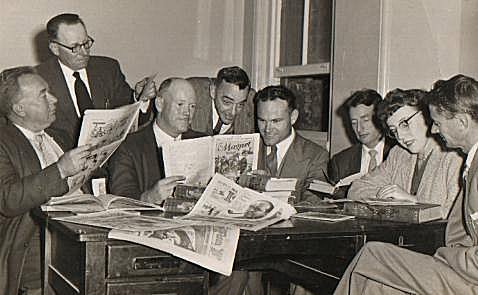
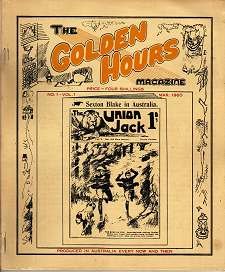
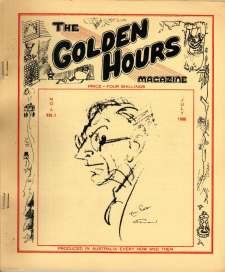
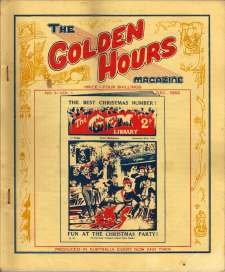
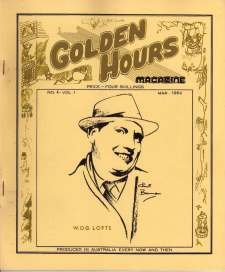
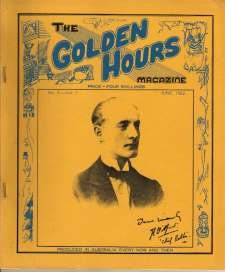
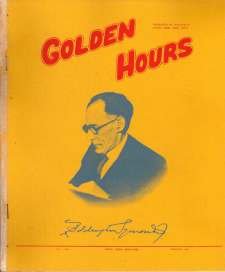
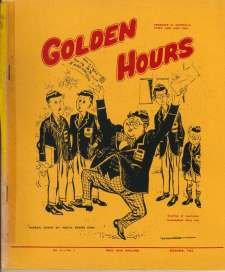
HOURS" REVIEWED (1990) Syd Smyth's Excellent Magazine So far as is known, this was the first periodical exclusively on this subject to be printed in Australia. In Canada the late William H Gander had commenced circulating by post "The Story Paper Collector" in January to March 1941. This was a pocket-sized and free paper, which was ideal for mailing overseas in letters. There were 95 issues of "The Story Paper Collector", the last dated July 1966. In England in 1946 the late Herbert Leckenby began "The Collectors Digest", a monthly magazine, which was carried on later by Eric Fayne for many years, and is still being published by Mary Cadogan, after more than 500 numbers. Some years after "The Golden Hours" Old Boys book club was formed in Sydney, Syd Smyth brought out his own magazine, with the enthusiastic help of the members of the local collecting fraternity. Naturally the magazine was named after the club. As Syd said in his opening editorial: "It is many, many months since I felt the first drivings to produce a small magazine. In Australia we are isolated in that there exists a time lag compared to the hub of all our old boys book interests - England. It seemed to me that apart from putting Australia on the map with a real, live magazine of its own, this very fact may be the way to eliminate that time lag to a large extent." In all there were seven numbers of "The Golden Hours Magazine", produced at irregular periods over four years from March 1960 to February 1964. As Editor, Syd was handicapped by the pressure of his business management, and this was probably responsible for the magazine terminating after such a short life. In one of my early meetings with Syd in Hyde Park in 1971, he very kindly supplied me with copies of all of "The Golden Hours Magazines". I had not previously been aware of its publication. My first priority was to read all the fine contents and my limited knowledge of the Old Boys book collecting hobby was considerably broadened. As none of "The Golden Hours Magazines" contained a table of contents, I have made a list of titles and authors covering all seven magazines, which may be helpful for other collectors. Sydney Club members Victor Colby, with his "Comments" and "Sexton Blake Library Reviews", and Ernie Carter with his "Column", were regular contributors. From the London Club, Mr W 0 G Lofts, with his "Facts and Figures", helped to enlighten us with much "Inside Information" on various editors and authors of "Old Boys" literature. In Issue 1 there appeared a very good article on "Sexton Blake In Australia", by Victor Colby. The front cover of this issue displayed a miniature reproduction of "UNION JACK 1d. (Vol 5 No 119, New Series, page 1). This cover was headlined "Sexton Blake In Australia", and at the bottom of the illustration it stated: "THE BUSH ON FIRE. Scorched and choking, Sexton Blake and Tinker tore madly along through the burning forest." For fans of Charles Hamilton, Issue 1 contained an article entitled "The School For Slackers" by Ron Hodgson. This school was High Coombe which Charles Hamilton considered his most polished creation. To the reader familiar with St Jim's, Greyfriars and Rookwood Schools, this would be surprising. "The School For Slackers" series helped to sell the "Modern Boy" in 1934. Mr Hodgson's article ran to 8 pages and analysed the leading characters at "High Coombe" in some detail. He also sketched the plot of the story in an interesting fashion. Probably there has not been a better outline of "The School For Slackers" in any old boys' magazine, and Syd secured it for his first number. Perhaps a greater 'scoop' in Issue 1 was a scholarly article by the late Stanley Nicholls entitled "Strange Harmony Of Contrasts: Wodehouse and Reed". This essay ran to over 6 pages of informative analysis and comparison of the school stories of Talbot Baines Reed and Pelham G Wodehouse. It must have taken Mr Nicholls some hours of painstaking research to prepare his contribution. What is it that makes a fine school story? Mr Nicholls summed it up perfectly, as follows: "In the work of both we find that satisfying quality, credibility, the thing that makes us say, "Those characters were real. I've known boys like them." From both writers we accept the situations, the events, and the characters. Both are readable in the sense that there is a constant flow of narrative, with an inducement in every chapter for the reader to continue." How much do the above qualities apply to the stories of Greyfriars, St Jim's and Rookwood Schools, by Charles Hamilton? Issue 2 included a very attractive article by G R Samways, headlined "Memories Of The Magnet Office". As a boy, Mr Samways did not go to a school like Greyfriars or St Jim's. As he wrote at the commencement of his essay: "My first job, found for me by the charity school at which I had spent nearly six years of Spartan training and iron discipline, was with the L S Starrett Company . "No prisoner, counting the weary days to his freedom, ever longed for liberation more desperately than I. Night after night I lay awake in my dormitory, yearning for the happy day when the school gates would clang behind me forever." Mr Samways started with unskilled labour at ten shillings a week in 1911, reading his favourite "Magnets" on Sunday mornings. He progressed to fifteen shillings a week in the office of a stock and share broker in 1913. Of this sum, five shillings went on rent. About this time, Mr Samways submitted a rhyme in praise of Greyfriars to the "Magnet" Office. Sub-Editor Maurice Down considered it "very good" and published it. Following this achievement, G R S wrote a series of poems on Greyfriars and St Jim's characters. These also appeared in print. Soon he became a regular rhymester for the two Hamilton papers. Then came a telegram from "The Magnet" Office, requesting his immediate appearance at Fleetway House. "Would G R S prepare a "Magnet" substitute story over the weekend?" That was the question put by Editor Hinton and Sub-Editor Maurice Down. Mr Samways accepted the formidable task with some trepidation. By Monday the job was nearly done, and it met with the approval of Hinton and Down. Soon Mr Samways became a member of the editorial staff of "The Magnet" Office, which meant an adequate salary, reasonable hours of work, and a pleasant and stimulating job. (All these advantages were missing in previous jobs.) This was now the eve of the outbreak of the Great War of 1914-18, which left many gaps in "The Magnet" Office. G R S gave an outline of an average day in the Editorial Office, with the characters of other members of the staff, and of how his own job was to handle bags of mail from young readers. In Mr Samways' opinion, substitute writers were essential to keep "The Magnet" publishing at awkward times when copy from the genuine Frank Richards (C H) was lacking. He thought they were unjustly maligned. The same would, of course, apply to the St Jim's sub yarns in "The Gem". Of interest is the revelation in the Samways article that G R S was responsible for prevailing on Editor Hinton to employ his old schoolfriends H W Twyman and Hedley O'Mant in the Fleetway Office. Mr Twyman also contributed an article for Issue 2. This was entitled "After The Lord Mayor's Show". He became editor of "The Union Jack". His six page essay deals with the history of the detective papers, such as "Thriller" and "Detective Weekly". In this issue there was included a three page advertisement from Tom Lambert of Norwich, England, which listed a wonderful variety of Old Boys papers and comics and bound volumes, boys annuals, etc, at what would be incredibly cheap price today. How would you like to buy "Magnets" 1932-36, 100 for £20, or 1938-40 - 100 for £12? Or how about "Gems" 1922-29 - 100 for £20? Or "Triumph" 1930-40 -100 for £5? Or "Union Jacks" 1926-33 - 150 for £10? In the comic line we have "Jolly", "Larks", "Joker" and "Jester" 1930-40 -119 for £5. (Not much demand for these in 1960, apparently.) Issue 3 contained a further article by G R Samways, entitled "Christmas Chimes - More Memories Of The Magnet Office". In this essay, Mr Samways wrote about the. Christmas numbers of "The Magnet" and "The Gem", and their colourful covers. G R S informed us that the Editor and staff regarded the Christmas Double Numbers of the early years of "The Magnet" as the highlights of their years work. Much care and planning went into these annual issues, which went into circulation in the British Isles some two or three weeks before Christmas Day. This seems very early and there must have been some reason for it. The numbers published a few days either side of Christmas were more like ordinary issues, although the covers often reminded the readers about the happy season. Issue 3 included an interesting leaflet printed by the Book Collectors Society of Australia. This announced that at the next meeting, several members of the Golden Hours Club would address the Society about the books and papers and comics covered by their hobby. It also stated that the Golden Hours Club met at monthly intervals for lectures and discussion evenings at the YMCA building, Pitt Street, Sydney. So it was a very active club in 1960, just three years after its formation. Mr H W Twyman supplied a further article in this issue headlined "I Raise Some Christmas Ghosts". This ran to about eight pages, and dealt with Christmas festivities in "The Magnet" Office. In conformity with the above articles and the date of Issue 3, December 1960, the cover displayed in colour a miniature copy of the front page of the Christmas Number "Gem" of December 1921, which was entitled "Fun At The Christmas Party". The cover of Issue 4 portrayed a realistic drawing of Mr W 0 G Lofts. The sketch was signed by C Brennan. In his editorial, Syd Smyth said the cover was a tribute to the hard work and devotion to the hobby by Bill Lofts. This was in March 1962, and now in 1990 he is still enlightening us with the results of his painstaking and careful research. The main essay in Issue 4 was by Mr Edward C Snow, and headlined: "Formulas Of Genius - Editorial Staff Memories Of The Fleetway House". This article gave us some interesting information on the career of the famous newspaper and magazine publisher, Lord Northcliffe, previously Alfred Harmsworth. The Lord, as Mr Harmsworth, revolutionised the printing and format of newspapers, and cheapened the price of his publications down to a halfpenny and a penny a copy, so bringing them within reach of the masses of the people. His famous first paper was called "Answers To Readers", soon shortened to "Answers". This was in the late 1880s. Soon after he began the famous "Comic Cuts", which was the forerunner of the magical children's' comics such as "Puck" and "Lot-o-Fun" and the "Jester" in the pre-Great War period, and "Chuckles", which just began in 1914, and the colourful "Tiger Tim's Weekly", "Rainbow", "Bo-Peep", "Chick's Own", "Jingles", and others in the fleeting two decades between the two worst wars in the history of human civilisation. Of course, Northcliffe's main field was his newspaper empire, beginning with such famous papers as the "Evening News", "The Daily Mail" and the "Daily Mirror". It was the war news in the Boer War at the turn of the new century, and later the Great War of 1914-18 which made them into great newspapers with huge circulations. In the field of boys papers, Northcliffe's Company, the Amalgamated Press published "The Boys Friend", commencing 1895, the "Boys Herald" in 1903 and the "Boys Realm" in 1902. The stories of Charles Hamilton appeared at times in all the above three. In "The Boys Friend" the Rookwood School stories appeared continuously from 1915 until 1927. Hamilton wrote about this fictional school under the pen-name of Owen Conquest. The two most famous Hamilton schools, "Greyfriars" and "St Jim's began in "The Magnet" in 1908 and "The Gem" in 1907. I have put the history of Lord Northcliffe in my own words, with the help of some facts found in Mr Snow's article. But now I will quote directly a short extract from his essay: "By 1920, Amalgamated Press was producing over a hundred magazines and periodicals, with a circulation exceeding ten million, and Charles Hamilton was either directly or indirectly responsible for one tenth of that output. "That meant roughly 1,400 men were employed as the result of his creations. "In his memoirs, in the Saturday Book, he boasted he had written sixty million words without ever seeing a rejection slip - only letters from editors asking for more and more." Issue 4 included an interesting short biography of Mr Bill Lofts entitled "Spotlight On W 0 G Lofts" by Derek Adley. Issue 5 began with a scholarly editorial by Syd Smyth on the life and death of Charles Hamilton. In it he discussed the extent to which the writings of Hamilton reflected his personal beliefs. Syd's opening quotation from Dr Johnson was certainly very applicable to the creator of Billy Bunter and the Famous Five: "Let not his frailties be remembered; he was a very great man." The first article in Issue 5 was an eight page outline of the life and career of "Hedley Percy Angelo O'Mant" by H W Twyman, who had contributed to previous issues, as previously described. The cover of Issue 5 displayed a fine photograph autographed by H O'Mant. He must have been a colourful personality. In this essay on Hedley O'Mant, Mr Twyman mentioned the unbearable pressures to enlist in Kitchener's Armies in the early months of the 1914 war. Many of the young members of the staff of the Amalgamated Press Office disappeared into the khaki ranks. Twyman, Samways and O'Mant - all three obeyed the call of duty and were fortunate to return to the famous Fleet Street home of the Boys papers, near to the end of the terrible conflict. The next article in Issue 5 was headlined "Fleetway In The Twenties", by Ernest L McKeag. Mr Lofts wrote in a foreword that E L McKeag was a "Most prolific author of Boys and Girls stories" which appeared in such papers as "Chums", "Champion", "Triumph", "Nelson Lee Library", "Magnet" (Serials), "Boys Friend Library" and the Aldine Publications. Mr Lofts added that "He was creator and writer of that popular feature in "The Magnet" - "Come Into The Office, Boys and Girls"." Mr McKeag stated in his reminiscences that "The early twenties were, I think, the heyday of boys (and girls) writers. "A guinea per thousand words was paid for our contributions - not a great deal it is true, but when a man could turn out twenty or thirty thousand words a week it was not to be squeezed at - when money was still worth its face value." Mr McKeag mentioned "beer at 8d a pint, cigarettes at 11 1/2d for twenty, penny bus fares and a slap-up lunch for half a crown." I might add that Great Britain had 1d or 1&1/2d postage on internal letters delivered within a few hours or the next day at the latest, and London newspapers were around 1&1/2d to 2d. And this was after the inflation which went on in the first Great War. E L McKeag informed readers that he lived in North Germany during the wild inflation period of 1923 and his income from story typing "paid in English money was worth five or six times its spending value in German Marks". In the end he was getting 18 thousand million marks for a British pound! The next composition of importance in Issue 5 was by the late Jack Murtagh of New Zealand on the subject of "Some Schoolboy Hypnotists". As the author said he had been "mixed up with hypnotism in the theatrical world for over ten years", he claimed to know something about this subject. In his article, Mr Murtagh analysed several stories in the companion papers which were based on schoolboys who imagined they had hypnotic powers. Naturally the fat and fatuous Billy Bunter deluded himself in several "Magnet" stories. As early as "Magnet" No 30, the story was headlined "Bunter The Hypnotist", whilst "Magnet" 1583, a different plot entirely, had the same title. Then in the "Gem" NO 413 we had "Grundy The Hypnotist", and in "Gem" 208 "The Schoolboy Hypnotist". In the "Nelson Lee" 2nd New Series there was a yarn called "Handforth the Hypnotist". There was scope for a lot of humour in the above issues of the school papers. Towards the end of this issue appeared a two page essay by Jack Corbett on the subject of "Frank Richards, The Down To Earth Author". Mr Corbett stated that Charles Hamilton was invariably plausible with his plots in his Greyfriars and St Jim's stories. He did not need to bring in "fantastic creations or impossible inventions". For example in the famous "barring out" series of 1928, the mere dropping of a letter by Skinner for the Headmaster to pick up, was the event "which set in motion the well worked out ensuing plot". Issue 6 came out in December 1962. The cover showed a copy of a "Billy Bunter" cartoon, drawn by Mr Illingworth, and reprinted by courtesy of Australian Consolidated Press Ltd. This drawing related to British Railways receiving a cheque for £400,000,000. Bunter as B R exclaimed, "Hurrah, chaps, my postal order's come". On page 92 of Issue 6, another cartoon by Illingworth was reproduced. This again brought in Billy Bunter in the role of a paying parent supporting an Etonian or Harrovian schoolboy. This sketch was based on the high cost of fees paid for boys at the leading Public Schools in England in 1962. Bunter was very much miscast as the carrier of the burden. He should have been the boy being held up by a staggering father. Syd Smyth on page 2 wrote probably his best editorial of the series. It dealt with modern criticism and evaluation of Charles Hamilton as the greatest of all writers of boys' fiction. As Syd stated, "I think it's fairly well accepted that our hobby centres around the writings of Charles Hamilton". Later he posed the question: "Does perfect writing make a perfect man?" Further on Syd examined the following aspect of Hamilton's work in our late Editor's words: "The question of revealing oneself in his writings is very well known and accepted. But surely this can be strained?" We know how many clever and realistic characters appeared in the Shakespearian plays, but their creator could not possibly have lived all their lives himself. He must have drawn largely on his wonderful imagination, and knowledge of humanity. As Syd put the matter neatly in regard to Shylock in "The Merchant Of Venice": "Was not Shakespeare a Jew, because, unless he was, how can he have written the character Shylock as he did? Perhaps Shakespeare was a Jew - but we know for sure he was a genius." With regard to Hamilton, Syd declared: "He was all too human - he would have been dull otherwise and he wouldn't have had the drive to create as he did." Syd Smyth revealed that he received a few letters from Frank Richards (C H) after the War. He also mentioned "the virile laying about him in "Horizon" and the Orwell business". Syd's conclusion was the perfect summation: "When a man can type out a story with a typewriter on his knees without a mistake, he knows his technique is perfect and he doesn't have to be told. But let us hope we will always want to criticise strongly, and defend fairly Charles Hamilton." The first article in Issue 6 was entitled "Peeps Into "The Magnet" Post Bag" and written by G R Samways. The author, who reached the position of sub-editor in the "Magnet" office, believed from his personal experience that "Letters To The Editor" columns had and have a very great influence upon the popularity of a newspaper or periodical. Mr Samways, who wrote some substitute Greyfriars stories, often had to help cope with a tidal wave of letters from readers from all parts of the British Empire and the United States. He stated that to many boys and girls the Greyfriars schoolboy characters "were not mere puppets of the author's creation, but living, vital beings, leading a real existence in a real school. A wonderful tribute, this, to the genius of Charles Hamilton, and his great gift of characterisation." Mr Samways asserted that "the prime favourite" of the readers was Bob Cherry. "Bob," he wrote, "had all the qualities which endeared him to youthful hearts - his sunny disposition, his courage, his sportsmanship, his irrepressible high spirits, and his championship of the underdog, all combined to make him not merely well liked, but universally loved." Mark Linley, the scholarship boy, was high on the list in the popularity poll, of correspondence. In Mr Samways words, "He lives for us in "The Magnet" pages, as a really fine type of English schoolboy, valiant in adversity, modest in success, good at games, and steadfast in friendship." G R S declared that Vernon Smith, "the bounder of the Remove, was always a popular character. Although he was often capable of caddish actions'. there was a better side to his nature, which frequently surfaced. "It was always excitingly uncertain what he would do next." Readers were constantly asking for more yarns about him. Harry Wharton had many admirers, for he was a born leader, but he was inclined to be too high handed and arrogant at times, and this detracted from his popularity. According to Mr Samways, the letter writers could not get enough of Billy Bunter. He summed it up perfectly as follows: "Not many readers liked him, a good many positively loathed him; yet he was a never failing source of mirth and merriment to all." As he put it in 1962: "Perhaps no character in all the range of English fiction has become such a household word." Naturally, George Wingate, the fine sportsman and captain of Greyfriars, was respected and admired by "Magnet" readers. The pompous but good-hearted Horace Coker of the Fifth Form, was a source of amusement to "Magnet" fans, both boys and girls. The next article in this issue was an essay entitled "Roving Thoughts On The BOP", written by Stanley Nicholls. This was the product of some scholarly research by the author into some of the early volumes of "Boys Own", before the period which he read as a boy, namely from 1911 to 1923. Mr Nicholls asserted that "No publication for boys ever gave better coloured plates than the "Boys Own Paper"." He added that "there was an imposing array of informative plates in colour on these subjects: British Army, birds, badges, football colours, Coats of Arms, fruit and berries, flags and funnels, cricket teams, and butterflies." Mr Nicholls mentioned that in numerous volumes there were serial stories by the famous Jules Verne, who was a pioneer of science fiction, and who wrote about submarines and rockets to the moon in the nineteenth century. Amongst other famous contributors to the early volumes of "BOP" he praised Talbot Baines Reed and R M Ballantyne. Reed wrote for the famous Boys paper such stories as the "Fifth Form at St Dominic's", "The Cock House At Fellsgarth" and "The Adventures Of A Three Guinea Watch". The next item in issue 6 was a further instalment of "Facts and Figures" by Mr W O G Lofts. He gave an explanation for Hamilton only typing the first six of the Cliff House stories in the "School Friend" girls paper. The reason, of course, was his huge workload with the big three boys schools, namely, Greyfriars, St Jim's and Rookwood. The following essay in the December 1962 number of "Golden Hours" was about "Snobbery In The Hamilton Stories", by J F Bellfield. The author declared that "Many of Charles Hamilton's most enthralling stories are concerned with the uphill struggle of characters such as Tom Redwing, Mark Linley, Dick Penfold and Tom Rawson to win the friendship of boys of a higher social class; boys who have wealth and social advantages far above themselves." The scholarship boys have succeeded through merit and moral integrity". Mr Bellfield asserted that although these boys were fine fellows, the real heroes of the stories were upper middle class boys like Harry Wharton, Bob Cherry, Jimmy Silver and Tom Merry, and aristocrats like Gussy and Mauleverer. He deduced from the Hamilton yarns that the real merit of the lower class boys was "to be able to rub shoulders with the sons of gentlemen on equal terms". Mr Bellfield concluded with the debatable statement that he believed Hamilton had a 'sneaking sympathy with snobbery'". He mentioned the fact that C H in his autobiography kept his own school a secret. The reader could infer from this that Frank Richards (Hamilton) did not think his school was a good enough one in the social scale. F Bellfield stated that Hamilton condemned snobbery in his stories, "but then he condemned gambling, whilst it is well know he was an addict". The next article was headlined "Those Old Jesters Of Mine", by Arthur V Holland. Having purchased a complete run of these comics covering the period from 1915 until almost 1930, I am very interested in this two page review in Issue 6. The author quite rightly nominated Constable Cuddlecook as the main attraction amongst the regular comic strips. He often got into hot water, but usually came out on top. In the course of doing his best, he would receive friendly smiles from the house maids, and pies and cakes from the cooks." "The Jester" was a family paper in its early years, with the comic strips suitable for children, and most of the stories were written for the adults. Mr H W Twyman contributed a further composition to "Golden Hours" entitled "Frank Richards Has Died, but Bunter Rolls On Immortal". He began by recalling memories of his own schooldays when his friend George Samways furtively read aloud the latest issues of the old red "Magnets" to his classmates. The boys were on the alert for the approach of any masters or prefects, because "The Magnet" and "The Gem" were prohibited as evil and degrading literature. Teachers who had known of 'the bloods, read by the Victorian generations, unjustly associated the good Hamilton papers with the bad, demoralising printed matter of their own youthful days. At the time of writing in December 1962, Mr Twyman described Bunter "as a figure that will remain immortal as long as English literature survives." "But," he added, "we "Magnet" specialists can tell them, he created swarms of only lesser real and rounded personalities as well." The seventh and final number of "Golden Hours" had on the cover a portrait of Mr F Addington Symonds, with his autograph underneath. He wrote a short essay about "Golden Days At The Fleetway House, for this issue. He was the Editor of "The Champion" boys paper in its early years in the 1920s. When the paper was first launched he was given a small office and a staff of one - a small boy to run errands. Soon he had a suite of offices and an editorial staff of 14. The next short composition was on the subject of "The Triumph In The 1930s", by Albert Watkins of New Zealand. With about 200 of this boys papers in my own collection, I have studied with interested this review several times. The paper had five or six stories per issue, with always three serials in 1930, according to Mr Watkins. For that year, he mentioned Mr E R Home-Gall in his dual roles of Rupert Hall and Edwin Dale for a series of 46 drawings and photos of the Great War, which were included in the following few numbers. Next item on the agenda was "A Half Hour With Charles Hamilton", by G R Samways. He only met the Grand Master of all school storywriters on one brief occasion. He described Hamilton at forty as "unassertive and unimpressive". He stated that Hamilton "knew little and cared less about the inner workings of the papers". Ernie Carter in his column remembered that many years ago there was an issue of Greyfriars characters on cigarette cards, and he found an advertisement in "The Champion" in 1923 offering Billy Bunter and Famous Five lantern slides for sale at prices from eight pence each. This proved the great popularity of "The Magnet" in those days. Syd Smyth, in his final brief editorial, gave his opinion that in no manner could the old school story papers be revived or survive. He mentioned that a recent attempt at reprinting the St Franks and Rookwood stories had failed. Little did Syd know that within six years the famous and very successful Howard Baker facsimiles of "The Magnet" and "The Gem" would appear in hardback format and with colourful dust wrappers. Syd's advice to a future editor to consult hobby club members as to the best of the stories by Charles Hamilton may well have been followed by Mr Baker. In summation, it is my belief that the "Golden Hours" was a delightful and very informative magazine, which lived all too short a life. The articles contributed by the men who held senior positions in the Fleetway House were highlights of the Golden Hours magazine. A series of these articles by one of them was later published in hardback book format.# |
bc |